26 Delegates, 17 Countries, One Shared Effort for Women’s Advancement and Peaceful Societies











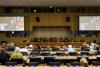

The 69th session of the United Nations Commission on the Status of Women (CSW) unfolded at a moment of deep turmoil for the international order and increasing opposition to women’s rights around the world—all taking place during the 30th anniversary of the landmark Fourth World Conference on Women and the adoption of the Beijing Declaration and Platform for Action.
Yet Commission participants displayed a clear sense of resolve and a hunger for bold ideas and fundamental questioning of the assumptions and premises of the modern world. It was to this desire that the Baha’i International Community (BIC) sought to contribute, particularly through exploring links between women’s advancement and the creation of peaceful societies.
“People’s faith in the global order as it stands today is being shaken, and they are increasingly seeking a compelling vision for the future, and a deeper understanding of those elements of the human spirit that propel action for the common good,” said BIC Representative Liliane Nkunzimana, who led the BIC’s delegation to CSW.
“That search must ultimately lead to every segment of every population working shoulder to shoulder for the realization of gender equality,” she added.
Highlighting grassroots efforts around the world
The BIC hosted and co-hosted 16 events over the course of CSW in collaboration with several dozen partners, among them Member States, UN agencies, and civil society.
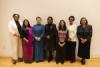
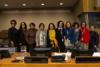
Central to its efforts was a delegation of 26 individuals from 17 national backgrounds—a diversity which allowed delegates to draw on grassroots experiences from around the world and to share insights into how local community-building efforts advance the cause of gender equality.
At one event, delegate Martha Moghbelpour, representing the Office for Social Action of the Baha’i community of India, drew on experiences from over 3,000 localities across India in her intervention. One example included a series of village gatherings that initially focused on supporting girls’ secondary education and subsequently gave rise to a number of other community-based initiatives, including a system of tutorial assistance, a community library, a community school, and ongoing spaces to discuss community health issues.
“In the end, all of this is possible when certain capacities are developed, certain attitudes about how we view each other, how we see in every individual a collaborator and a potential promoter of community well-being—irrespective of caste, religion, background, or gender,” Ms. Moghbelpour explained.
In another event, Andrea Salguero, Director of the Office of Public Affairs of the Baha’i community of Canada, described the significance of efforts across Canada to provide, at the neighborhood level, classes for children and young people, to organize service projects, and to host spaces where community members of all ages can gather to reflect on the condition of their neighbourhood and strengthen bonds of friendship.
“What we are learning is that as these educational programs bring both women and men together with the stated aim of building a sense of community where we live, they are also promoting greater gender equality in important ways,” said Ms. Salguero. “In these small pockets at the neighbourhood level, where these initiatives are happening in a systematic way, we can begin to see glimpses of greater gender equality, as new patterns of relationships between men and women gradually emerge.”
Exploring realities at the regional level
Events hosted by the BIC also facilitated explorations on larger, regional contexts, including how needs and requirements can differ from one region to another.
A roundtable discussion on the Arab region, for example, created space to explore the advancement of women according to the realities of that region. Conducted in both Arabic and English with translation, the event drew participants from a variety of countries, including Lebanon, Iraq, and Yemen.
“How do shifts in mindsets and social norms take place in our particular region?” asked BIC Representative Saba Haddad, originally from Iraq, who organized the discussion. “What examples do we have of communities that have actually been able to make such shifts? These were questions at the heart of a very rich conversation.”
In collaboration with the government of Canada, BIC delegates also organized a French-language event, with English translation, that drew participants not only from Canada but also francophone African nations. Focused on taking stock of insights from 30 years of working to advance gender equality, the event featured speakers including Canadian Senator Marilou McPhedran.
“The agency to live our fullest possible life is very much affected by the spaces in which we live,” Senator McPhedran said. “But it is what humans carry inside that really allows us to navigate wherever it is that we have to be, with whomever we need to be.”
Youth, indigenous, and feminist voices from Australia and Papua New Guinea also contributed to an event that drew participants from across the Pacific islands, and highlighted a range of community-based initiatives.
“It’s wonderful to see that some of the solutions for long-lasting gender equality are coming from places where a whole-of-community approach is being taken,” said Awa Momtazian, Director of the Discourse on Gender Equality at the Office of External Affairs for the Australian Baha’i community, who organized the event.
Working in full partnership
Running through much of the BIC’s engagement at CSW was the observation that commitment to gender equality, on the part of a large cross-section of a local population, contributes to the creation of communities with greater degrees of trust, collaboration, and peace.
This theme was explored in the BIC’s statement to the Commission, titled “In full partnership: Women’s advancement as a prerequisite for peaceful societies.” Drawing on experiences of Baha’i communities worldwide, the statement takes stock of lessons learned over the past 30 years, and warns that hard-won gains are tenuous without enduring transformation among individuals and across communities and societies.
“Until transformation takes root within mindsets and finds expression in culture, the underlying causes of prejudice and discrimination, embedded in the systems and structures of societies, will remain unquestioned and will continue to perpetuate injustice,” the statement reads.
These ideas were considered at a roundtable discussion that drew some 70 attendees in-person and online.
“Gender equality is not only a goal, but a necessary condition for peace and prosperity,” said Ms. Nkunzimana, who moderated the event, in opening remarks.
“We will establish enduring peace by ensuring every member of society—including women and girls—are in a position to shape all aspects of the community: in the home, in the neighborhood, in economical arrangements, in educational processes, in negotiating peace processes, in establishing harmonious relationships with nature, and shaping learning environments.”
Other keynote speakers expanded on various contributions women make to peaceful societies, including through promotion of necessary moral and ethical qualities.
“Women are the pillars of society. They give birth to this world. They offer wise counsel to this world,” said Malicka Mukubu, CEO of National Office of Tourism, Democratic Republic of the Congo. “They’re managing families’ assets with a knowing intuition, guiding young souls on the path of virtue, and imparting the core values that define our existence.”
Also part of the delegation’s initiatives was a hybrid dialogue centered on means of responding to injustice through constructive agency organized by the Baha’i International Community’s Geneva United Nations Office. “History is filled with examples of the devastating consequences of oppression. But it also provides profound insights on how to…address injustice in ways that don't deepen divisions, but instead seek to build higher levels of unity and pathways towards lasting peace and justice,” said BIC Representative Simin Fahandej, who moderated the event.
Moving forward
In remarks to summarize and close the “Full Partnership” event, Principal Representative of the BIC, Bani Dugal, reflected on progress she had seen in the women’s movement since the Beijing conference and its 12 “areas of concern” to advance women’s rights around the world.
“I’m filled with a lot of hope and joy,” Ms. Dugal said. “I know there is a lot of conflict around the world, a lot of pain and suffering. However, I do see that we are connecting. And there is an awareness that wasn’t there 30 years ago.”
“Systems of oppression are co-related and connected,” she continued. “But our movement, and all the movements—be they the environmental or gender equality, or other movements around the world—are also interconnected. And we are moving forward.”