Antidotes to polarization: BIC highlights the importance of trust as the UN General Assembly enters its 81st session


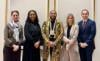


Amidst what many feel are rising levels of polarization around the globe, world leaders gathered at this year’s High-level Week of the United Nations General Assembly (UNGA) to reflect on the theme of “Restoring trust, managing transformation: A United Nations that delivers for all.” The choice of that theme demonstrates the world’s ongoing search for approaches that can bring about enduring peace and stability.
Joining diverse actors on the sidelines of these meetings, the Bahá’í International Community (BIC) took part in more than a dozen events hosted by current and former world leaders, civil society representatives, academic institutions, and religious and faith-based organizations. Topics under consideration ranged from global governance to UN reform, development to climate change, gender equality to youth advancement, artificial intelligence to interreligious tolerance.
Across such a variety of areas, the BIC returned again and again to the heart of UNGA's central theme: how trust can effectively be cultivated on the international stage.
“Trust emerges when you know that someone has your best interests at heart,” said Principal Representative of the BIC, Rachel Bayani, at the “New York Policy Lab, Democracy 2050 – Building the Democracy to Come” event hosted by Club de Madrid, the world’s largest non-partisan, non-profit forum of democratic former Presidents and Prime Ministers.
“Naturally, nations and their leaders have the responsibility to look after their own population. But today, that alone is no longer enough,” said Ms. Bayani.
As conversations at UNGA proliferated around the four tests of power described by Secretary-General António Guterres—armed conflict, economic inequality, climate change, and threats associated with AI—BIC representatives considered what other responsibilities world leaders hold, and how they relate to trust.
“In a reality like ours today, for trust to emerge, we need to strengthen the capacity of nations and countries to be deeply concerned with the well-being of other nations and that of humanity as a whole,” said Ms. Bayani.
“The BIC feels that this essential capacity is the starting point for the transformation of our global order. And that the exploration of what allows such capacity to emerge needs to be at the heart of the discussions we are having.”
Trust as a capacity to be built
Throughout the High-level week, the BIC explored how trust is far from an abstract concept, but rather is in itself a capacity that must be learned and fostered—and one with deeply practical implications. If policies on the national and international stages were more consistently formulated with an awareness of the impact they might have on the whole of humanity, how might relationships among nations be different from what is seen today? If educational systems were concerned with expanding, from young childhood, a sense of global identity, how might individuals from different backgrounds relate to one another? Questions such as these, together with conditions that can lead to the emergence of trust, were considered by the BIC with its colleagues.
BIC Representatives also considered how trust can emerge when obstacles preventing the meaningful engagement of diverse populations in the construction of a flourishing society are removed. “If we imagine different groups of people—women, men, youth, indigenous communities, minorities, etc.—as letters in an alphabet, the implications of underrepresentation become very clear. An alphabet missing key letters cannot form certain words at all, regardless of the writer,” said BIC Representative Daniel Perell, speaking at an event hosted by GWL Voices that examined women’s leadership in UN climate processes.
“Progress will come as more voices, perspectives, and lived experiences form part of the narrative we craft together. With more letters, we can write more richly, more completely, and in ways better suited to the challenges we face,” said Mr. Perell.
Across five different events on subjects such as multilateralism, the future of governance, women in leadership, as well as the role of the private sector, Mr. Perell highlighted the idea of shared endeavor as a common thread tying together efforts seeking new approaches to the challenges before humanity.
“At this moment, we see a real tension between the inter-national, the relations between nations, and the global,” Mr. Perell said at an event hosted by the World Benchmarking Alliance, “the former being the types of problems the UN was established to address, and the latter being the types of challenges humanity faces today.”
“But this tension can be solved through conversations with diverse stakeholders, representing different segments of society, coming together in a constructive atmosphere and learning from each other,” Mr. Perell added.
“Each of you represents a different piece of what ‘global’ means. It is through this kind of conversation, across sectors that too rarely share a table, that we begin to see problems as shared, and start closing the very gaps that seem to be widening on all sides.”
The role of youth
The theme of universal participation was further explored in a discussion hosted at the BIC Office on how to foster social conditions that can best release the immense potential of young people toward the betterment of society.
Reflecting on this theme, David Rupa, Principal Advisor for International Relations at the National Youth Development Authority of Papua New Guinea, highlighted that development must include an understanding that young people have agency and play a significant and distinct role in ensuring the well-being of their entire community.
The contribution of youth, he said, like that of every segment of society, is indispensable if a whole population is to move toward collective prosperity.
Beyond naive optimism
“To believe in each country’s capacity to care about the well-being of humanity as a whole is not naive optimism,” Ms. Bayani said in subsequent reflections the proceedings at UNGA.
“It is a recognition of what has already been achieved: that we have learned to see beyond tribe to nation, and beyond nation to an interdependent world. That we have, even in the darkest hours, produced instruments of cooperation, of law, of humanitarian solidarity.”
“When leaders believe in that capacity, they create the space for it to emerge,” Ms. Bayani continued.
“Because we know that for someone to be able to achieve something, they must have faith in the fact that they can do it.”