Documentary Film on Persecution and Resilience of Iranian Baha’is Shown to UN Audience in New York
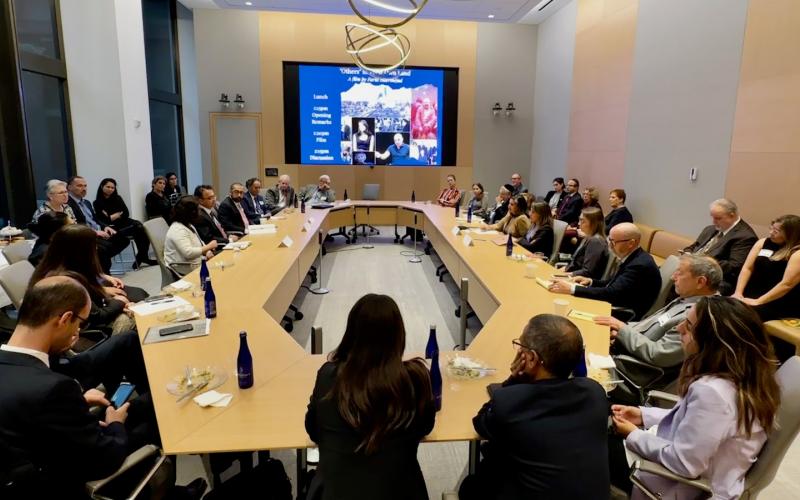
A documentary film about the institutionalized persecution of the Baha’is in Iran, 'Others' in Their Own Land, by the Iranian-Canadian journalist Farid Haerinejad, was screened last week at the Baha’i International Community’s (BIC) United Nations office in New York. The event was attended by the UN special rapporteurs for the human rights situation in Iran and for freedom of religion or belief, Javaid Rehman and Nazila Ghanea, who spoke during a post-screening discussion.
UN officials and mission delegates, civil society and human rights activists, Baha’is with personal experience of persecution in Iran, and other guests, also attended.
Nazila Ghanea, the Special Rapporteur for freedom of religion or belief, said that because human rights law was still a “skeletal” language, it was “in the medium of arts and film that we see with our own eyes what is happening” to the Baha’is in Iran.
The New York screening was held on the side-lines of the United Nations General Assembly’s Third Committee session. Iran’s government has for many years been cited during the annual Third Committee for its ongoing and widespread human rights violations against the Baha’is, Iran’s largest non-Muslim religious minority, as well as against other religious minorities, ethnic groups and women.
The UN Special Rapporteur for the human rights situation in the Islamic Republic of Iran, Javaid Rehman, who attended the screening, said during the panel discussion that “the Baha’is, as we know, constitutionally, live in an apartheid, they are not recognized, they are the largest non-Muslim religious minority and yet they live in a legal vacuum.” He added that “these are not historical concerns, this is happening right now, right at this time, the Baha’is are being persecuted, targeted, victimized, tortured.”
Baha’is have been persecuted by the Iranian government since the 1979 Islamic Revolution through executions and arbitrary detentions, denial of higher education and public sector jobs, the closure of businesses, confiscation and destruction of properties and widespread official hate speech.
The Iranian Baha’i community also experienced a two-month crackdown earlier this year, starting at the end of July, when almost 250 Baha’is were targeted. Homes in the village of Roshankouh were also bulldozed—as seen in videos published online at the time.
'Others' in Their Own Land—consisting of personal interviews with Baha’is, and expert testimonies by human rights lawyers, activists and scholars—joins a wave of films on the Iranian Baha’i community and the persecution it faces. The film was first broadcast in November 2021 on the satellite channel Iran International to an audience of several million inside the country.
Opening with a recording of a speech by Ayatollah Ali Khamenei, Iran’s Supreme Leader, saying that the Islamic Republic respects “freedom of religion” and that anyone claiming to have been persecuted for being “different” is lying, 'Others' in Their Own Land follows the stories of Baha’is who either lost loved ones or themselves experienced torture, imprisonment and the denial of livelihoods or education because of their beliefs.
The film also looks at Iran’s history of anti-Baha’i propaganda. Anti-Baha’i sentiment and policies began with 19th-century pogroms and continued with official support under Iran’s past ruler, Shah Mohammad Reza Pahlavi, before the 1979 Revolution led to the execution of hundreds of Baha’is after the Revolution and the establishment of systematized policies of persecution under the Islamic Republic.
The human rights lawyer Mahnaz Parakand explains in the film that Article 13 of Iran’s constitution denies Baha’is their rights and refuses to recognize the Baha’i Faith as a religion. Ladan Boroumand, of the Abdorrahman Boroumand Center for Human Rights in Iran, adds that “systematic discrimination of the Baha’is is considered one of the greatest violations of human rights in the world … Baha’is are in great danger at all times.”
“The making of the film was an illuminating journey for me,” the filmmaker Haerinejad said, in a statement. “Over two years, I met many Baha’is in various countries, and they graciously shared with me their stories, explaining generations of hardship and discrimination.”
Simin Fahandej, Representative of the BIC to the United Nations, who spoke at the New York screening, said that showing the film so close to the UN was sure to “bring joy to the Baha’is in Iran” and that the BIC was pleased to make the film available to a UN audience even as “our hearts go out to everyone who is suffering as a result of recent events in the country.”
“Growing worldwide support for the Baha’is in Iran sends a clear message to the Iranian government … public voices will continue to be raised until the persecution comes to an end and until the Baha’is can live as full citizens in their own homeland,” Ms. Fahandej added.
Past films on the Baha’is in Iran and on the Baha’i Faith include The Baha’is of Iran, a 2010 film produced by Kasra Naji for BBC Persian, Education Under Fire, on the denial of higher education by Jeff Kaufman, Iranian Taboo, by the Iranian-Dutch filmmaker Reza Allamehzadeh, The Gardener, a 2012 study on the Baha’i Faith by director Mohsen Makhmalbaf, The Gate, directed by Bob Hercules, which looked at the early history of the Faith, and three films (To Light a Candle, 2014, Changing the World, One Wall at a Time, 2017, and The Cost of Discrimination, 2017) by Iranian-Canadian filmmaker Maziar Bahari.
More than a dozen other Baha’i communities around the world have also scheduled screenings for this month or next.