Promoting an inclusive society for a peaceful Yemen: A panel discussion hosted by BIC’s United Nations office in Geneva


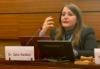
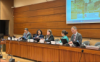
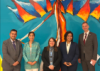
On the sidelines of the ongoing 57th session of the United Nations Human Rights Council, the Bahá’í International Community’s (BIC) office in Geneva, in co-sponsorship with the Permanent Mission of Luxembourg to the UN, hosted a panel discussion on 27 September at the Palais des Nations titled “Looking beyond: Promoting an inclusive society for a peaceful Yemen.” Participants discussed the diverse constituents of Yemeni Society and explored fundamental principles and effective strategies to foster unity and promote progress in Yemen.
The panel’s opening remarks were presented by Mr. Luc Dockendorf, Deputy Permanent Representative of Luxembourg to the UN, and joining him on the panel were Professor Nazila Ghanea, UN Special Rapporteur on Freedom of Religion or Belief, Ms. Noemi Robiati with Education Cannot Wait, Ms. Nasmeh Mansoor with Peace Track Initiative, and Dr. Saba Haddad, a BIC Representative to the UN.
Moderated by Dr. Nader Al-Sakkaf with the Office of Public Affairs of the Bahá’ís of Yemen, the panelists discussed several approaches to empowering all the constituents of Yemeni society, including women, children and individuals from various religions and beliefs, in building peace and driving progress. Highlighting the rich social fabric of Yemeni society and its potential for resilience and unity, Dr. Haddad said, “Yemen is a diverse country and is home to different groups that share a common identity, such as religious minorities or tribal leaders … they all are stones in the beautiful mosaic of Yemeni society.”
Among the highlighted approaches to peacebuilding was ensuring the legal safeguarding of the rights of minorities, including the Bahá’í community in Yemen. In this regard, Dr. Haddad noted, “Despite the diversity of the [Yemeni] Bahá’í community and its genuine wish to contribute to the well-being of Yemeni society, unfortunately, the community has been subjected to discrimination and persecution in recent years.” She added that promoting a thriving and peaceful society, where everyone has a sense of belonging and is serving the common wellbeing, “requires engagement, not only from the side of the government through laws that do not discriminate against minorities, but also environments at the grassroots level that foster social dialogue between the different components of society and encourage participation in the decision-making process at the local level.”
The panelists also discussed the critical role of media in elevating inclusive narratives and promoting unity over exclusion and targeted hate-speech. Dr. Haddad noted that diversity of media sources -both traditional and social media- present “an opportunity to counter narratives that are based on prejudice and division, because it allows active participation in the public discourse carried out via the media by all.”
Central to the approaches and strategies discussed was the recognition of the nobility of all human beings. Dr. Haddad shared that in order to truly transcend differences, people need to examine their understanding of identity and belonging.“Do we see differences as a way to draw divisions or are we appreciating the beauty of diversity?” she asked.
The panel discussion was attended by the permanent missions of Austria, Belgium, Canada, Costa Rica, European Union, Germany, India, Panama, and the United Kingdom, in addition to several international organizations.