‘Change Called Us Here’: Reflecting on Women Deliver 2026
By Liliane Nkunzimana
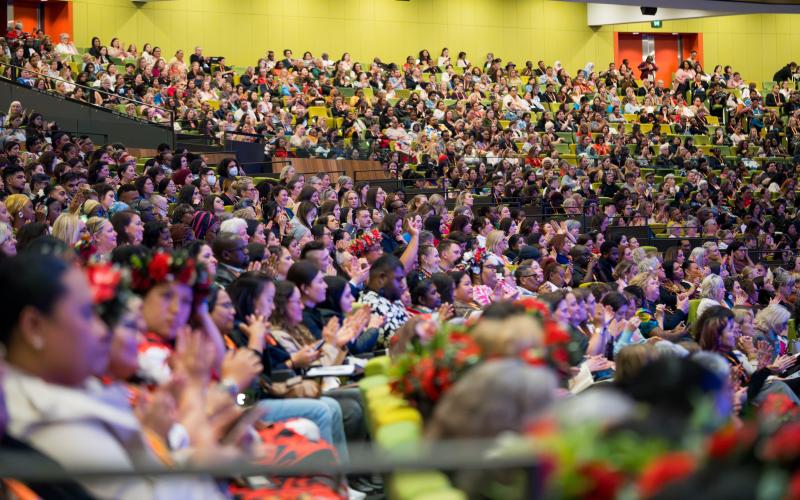
“Do not lower your standards.” These were the closing words spoken by Jacinda Ardern just as my colleagues and I entered the Women Deliver plenary hall. Despite our best efforts, we missed her entire session, as ours had run over; but I think we caught what we needed to hear.
Nearly six thousand attendees from 189 countries gathered in Naarm (Melbourne), Australia, for this triennial conference to reflect on what has been a challenging time for the feminist movement. Women Deliver has evolved from a women’s health focused international conference, to a movement building gathering that convenes gender equality actors to consider major questions facing the movement from climate change to maternal health and from education to global governance.
“Change called us here,” has been the rallying cry of attendees, many of whom are grappling with what Women Deliver CEO, Maliha Khan, has described as the “rage and grief” many feel in the face of political polarization and rising authoritarianism. Such disturbing trends have further entrenched patriarchal attitudes and emboldened a reassertion of harmful norms, often under the guise of cultural or ideological preservation. And all of which pose formidable obstacles to progress in countless countries. At Women Deliver, activists, advocates, government officials, and more came to create solidarity and encourage each other to keep moving forward.
What struck me the most about this particular convening was the difference it makes when these large international gatherings are held closer to specific populations. Women Deliver was co-hosted by the Oceania Pacific region; and the convivial attitude and joy of peoples who often center family and community was a refreshing break from the United Nations formalities I deal with on most days. Yet such ease of engagement in no way obscured the protocol, respect, and hospitality that emanated from our gracious hosts over the four days.
Of the thousands who attended Women Deliver, 44% came from the Pacific region. So what happens when the international comes closer to the regional? It becomes much easier to appreciate particular lives, needs, and perspectives, and to imagine how they can influence global policy-making. This was the aspiration behind an event organized by the Bahá’í International Community, in collaboration with the Kiribati Ministry of Women, Youth, Sport and Social Affairs, along with the Australian Bahá’í community’s Office of External Affairs. We heard from actors in the Pacific that their work for gender equality had often been lost as regional priorities were subsumed by international agendas. We heard that, until the Pacific population can be perceived as a source of potential rather than a problem to be solved, progress will remain elusive. Communities need to be worked with much more closely, and their priorities better understood, for this to become real.
As I leave Naarm (Melbourne), back to New York, I am heartened by the feminist movement’s persistence. And as one conference attendee said, the equality of all people is a fundamental truth, and the truth always comes out. Not even the gloom of current events can prevent this—if we keep our standards high.
Liliane Nkunzimana is a Representative of the Bahá’í International Community to the United Nations