The Role of Faith Based Organizations in Water, Sanitization and Hygiene
This has been momentous year for efforts to ensure access to clean water, sanitation, and hygiene (WASH). The recently adopted Sustainable Development Goals (SDGs) address a variety of water-related issues, including SDG 3 on health and well-being, SDG 6 on water and sanitation for all, and SDG 11 on safe and sustainable settlements. This year is also the last year of the 2005-2015 “Water for Life” decade of action.
Religious organizations are a natural partner in work of this kind, for water is central to the scriptures and practices of virtually every religious tradition. Time and again water has been associated with qualities of spirit such as purity, cleanliness, and refinement.
In this lies a lesson as important to the development practitioner as the congregant: that while hygiene and sanitation are central to physical health, they also play an indispensable role in emotional, psychological and spiritual health.
Cleanliness is an indispensable aspect of human life well lived. To be denied access to the facilities necessary to maintain conditions of basic sanitation is to face a significant form of hardship.
The Centrality of Dignity
One powerful lens which can be used to frame and understand WASH-related issues is the concept of dignity.
Human beings aspire to lives of dignity and nobility, and conditions lacking in basic sanitation are contrary to such dignity. In this can be found a powerful point of commonality between the teachings of the great religious systems and the international relations architecture.
The first article of the Universal Declaration of Human Rights, for example, states that: “All human beings are born free and equal in dignity and rights.” Dignity is universal and inherent in human nature; it does not have to be won or earned.
All people therefore deserve access to facilities and resources that are in keeping with that innate dignity. And religious communities and faith-based organization have an important role to play in ensuring that happens.
Human Capacity as a Means of Implementation
Water related goals and objectives are, in many respects, quite formidable. To take just one example, 2.4 billion individuals do not currently have access to improved sanitation facilities, and will need to be provided that access.
What, then, are the means by which WASH-related objectives will be met? Who will do this work and in what ways?
Some aspects of water management and sanitation are administered at the regional or national level and must be addressed at the level of policy and procedure. But water is also closely tied to lived realities at the local level. The capacity of people, both individually and collectively, is therefore a vital means of achieving goals on water, sanitation, and hygiene.
Strengthening such human capacity, of course, includes the acquisition of technical and scientific skills. But it also encompasses social capacities at the level of the community such as the ability to forge consensus around common values and priorities, to build a shared vision of the future and pursue it through acts of collective volition, to value difference of opinion and build on difference of background, and to nurture collective ownership of the means and direction of community development.
Such collective capacities play a crucial role in local development efforts of all kinds, ranging from digging a well or laying pipe, to addressing attitudes and habits regarding practices like the collection of water or open defecation.
Central governments have primary responsibility in insuring access to basic services of sanitation and hygiene. But there is increasing appreciation in development circles of the concept of “localization” – the idea that development initiatives must be owned and supported at the local level by the local population if they are to be truly sustainable over time.
The Role of Religious Communities as Facilitators of Action
Religion has been a feature of human civilization since the dawn of recorded history and has prompted multitudes to arise and exert themselves for the well-being of others. What, then, is the role religious communities have to play in WASH-related efforts?
First and perhaps foremost, because it speaks to questions meaning and ultimate purpose, religion reaches the roots of human motivation. In this regard, religious faith can serve as a powerful tool for summoning the common will and generating the volition to act
Religious communities are large and cohesive constituencies. The active engagement of their membership can therefore be a powerful way of raising awareness on given topics and mobilizing significant resources.
In many contexts religious institutions and leaders also service as the voice of moral authority, ensuring that, as growing numbers of individuals strive to apply spiritual principles to improve conditions of the community, the integrity of their endeavors is not compromised. They can give attention to the human impact of efforts, ensuring that – beyond the construction of physical facilities, the expansion of economic opportunities, and similar objectives – human well-being in its many dimensions is growing.
Religion also sheds light on the moral, ethical and spiritual causes of material challenges, and suggests means by which those root causes might be addressed. Why are some populations almost completely excluded from basic services of hygiene and sanitation? What values and attitudes allow such disparities? What steps will need to be taken to build systems reflecting greater degrees of equity, justice, and solidarity? Religion can inform and support a conversation on fundamental questions such as these.
Communities of Practice and Learning
Finally, it should be noted that the link between religious conviction and service to the common good is by no means automatic. It is entirely possible, for example, to have a congregation of noble-thinking and well-intentioned adherents whose actions do little to contribute to the betterment of society.
Clearly, there is much to learn about how noble ideals become expressed in committed, sustained action. In this sense, religious communities can be understood as communities of practice and learning in which spiritual teachings are translated into social reality.
Within them, a process of capacity building that enables people of all backgrounds to participate in the transformation of society – and protects and nurtures them – can be set in motion.
How this process unfolds in different contexts and diverse environments promises to be an area of rich exploration in the coming years.
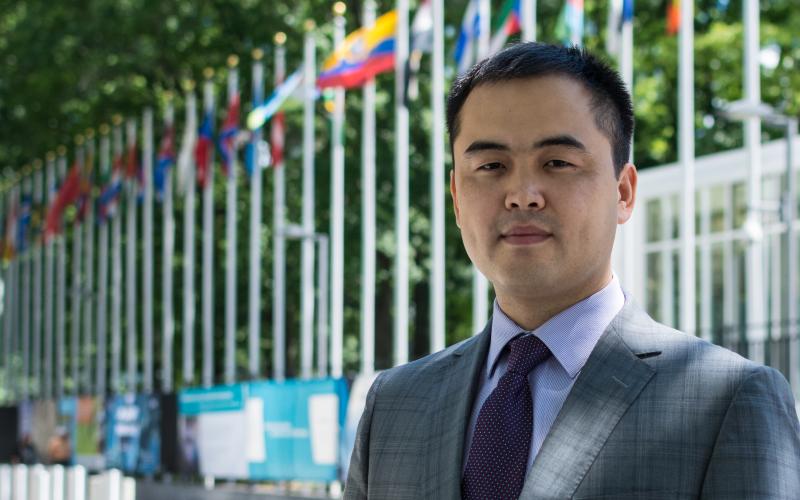
-- By Serik Tokbolat, Representative of the Baha’i International Community to the United Nations
[This perspective is adapted from remarks made by Serik Tokbolat of the Baha’i International Community’s United Nations Office on 26 September 2015 at a roundtable on water and sanitation hosted by UN HABITAT and the Global Interfaith WASH Alliance.]