View from the Interns: Reflections on the 2025 Session of the High-Level Political Forum on Sustainable Development
By Kira Diaz
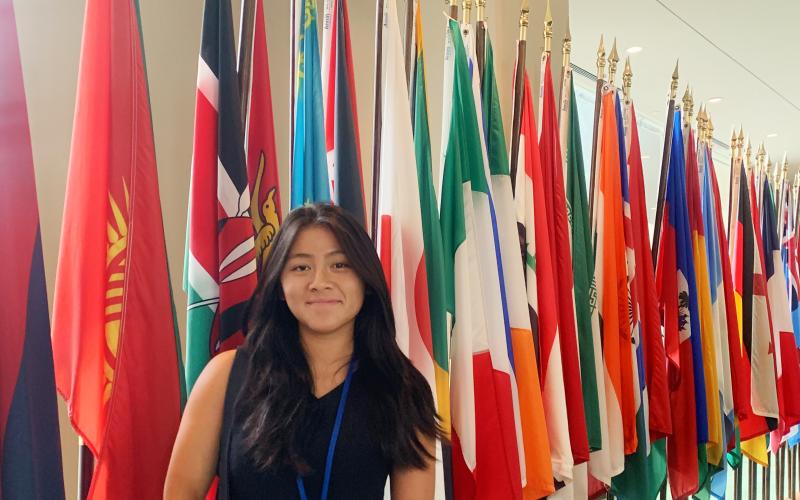
Untapped Reservoirs: The Role of Youth in a Transforming Society
I recently had the privilege of attending this year’s High-Level Political Forum on Sustainable Development (HLPF), where Member States and civil society converged to discuss the Sustainable Development Goals (SDGs) and plan our course toward the ambitious 2030 deadline. This year’s HLPF was charged by the urgency to work together to counter the alarming lack of progress and backsliding of the SDGs. Against a global arena of increasing tyranny, devastating natural disasters, and widespread conflict, our collective future often feels perceptibly bleak. Yet, amidst the formal proceedings of HLPF, I observed how one group in particular consistently displayed an unparalleled curiosity, asked questions that demanded concrete solutions, and pioneered action in unique and outstanding ways: youth delegates.
In a system as deliberate and consensus-driven as the United Nations, and where many HLPF events involved formality or rigid adherence to protocol rather than active exploration, I saw, as a youth myself, that the passion and acute sense of justice exhibited by younger generations stood as a source of hope and possibility. Youth were not just observing; they were shedding light on urgent issues that are often overlooked on the international stage. While the Member States’ reports on SDG progress are undoubtedly important, constraints of the space prevent a deeper analysis and exploration of root causes. A session can often remain at the surface level of declaration and rhetoric, rather than exploring concrete steps that bridge commitment into action. Youth, however, brought a vital jolt of innovation to the table as they are not as influenced by the status quo, and in many instances have the motivation to take courageous steps leading to progressive and transformative change within institutions.
While attending a general debate in the main plenary hall, I observed a youth delegate take her seat at the panel and speak clearly, raising an issue I had not yet heard any other delegate address: the urgent need for global regulation on artificial intelligence. She highlighted that there are currently no robust systems in place to protect young people from the improper and excessive use of AI, and urged that the youth of today cannot keep waiting for appropriate regulations to be put in place. She spoke of the rampant spread of false information on social media platforms, amplified by AI, and the insidious erosion of critical thinking skills as more people rely on AI to generate their thoughts for them. The delegate’s remarks were not simply rhetoric, they were rooted in our generation’s lived realities.
It is important that youth are actively engaged in, and have influence on, dialogue related to the progress and challenges around advancing the SDGs. Youth are uniquely positioned to bridge the gap between grand political declarations and the lived realities on the ground. Youth are digital natives, adept at mobilizing, communicating, and innovating at speeds that traditional diplomatic channels would greatly benefit from. The activism of youth is not confined to conference halls; it spills out into the streets, onto social media, and into local communities, creating a powerful environment that amplifies the HLPF’s discussions far beyond its immediate audience.
Later, in the more intimate setting of a side event on gender equality, I watched as the room filled with youth delegates, until no seats were left and many had to stand. What was unique was that youth were the prominent voice during the allotted time for questions, raising awareness on how we should address the surge of gender-based hate on social media, how to combat misogynistic social practices and shift harmful social norms that are deeply ingrained in our society, and how to raise awareness and promote action among more youth in advancing gender equality. I was inspired by this dialogue among youth, who, having been disproportionately impacted by the negative consequences of social media and AI, were able to offer essential perspectives rooted in a different lived reality that older generations may not be familiar with.
Unburdened by diplomatic protocols and political gain, youth delegates are able to demand action and accountability with foresight. The presence of youth delegates at HLPF is an invitation for governments and global organizations to work together with youth and enable them to turn their ideas into actions, and further, into policy. The UN specifically can benefit from the energy and participation of youth to drive innovation into the current SDGs and to ensure their relevance in a rapidly changing world.
The challenges the United Nation faces—vested interests, short-term thinking, and long-standing prejudices—are human problems, not simply defined by age, but by our species as a whole. Therefore, it is important that youth are able to make key contributions in addressing these human challenges as a rising generation of protagonists. It is time for us to cast distractions aside and to work together, youth alongside older generations, to build the future we long for with informed and tangible plans to advance the SDGs. The energy of youth, our curiosity, and our unwavering commitment are not just demands; they are offerings of partnership, ready to transform the quiet halls of diplomacy into vibrant arenas of real, impactful change for a future we genuinely need now. We all have a sense of youth in us, despite age, and even the most veteran diplomat or activist can find that source of inspiration inside themselves to transform the world toward a better future for all.
Kira Diaz is an intern at the Bahá’í International Community United Nations Office in New York