View from the Interns: Reflections on the 64th Session of the Commission for Social Development
By Luana Martins


“Love as a principle, order as a foundation, and progress as a goal” - Why the Global Care Crisis Demands a Shift
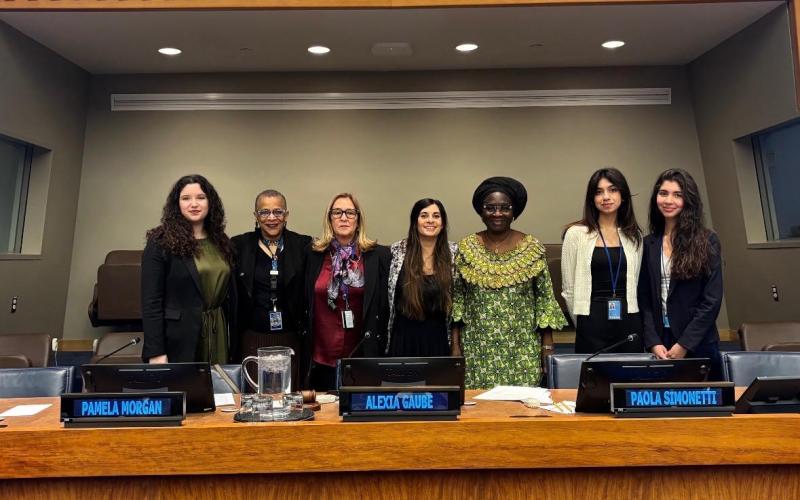
This year’s 64th Session of the Commission for Social Development (CSocD), which I had the opportunity to attend as an intern for the Bahá'í International Community, focused on reducing inequality and advancing socially equitable, coordinated policies. As part of this theme, the topic of “care” and its many forms was frequently discussed. Growing up in a country that carries positivist philosophies in its motto, I couldn't help but think of Auguste Comte's sacred formula of positivism, which inspired the title of this article. "Love as a principle, order as a foundation, and progress as a goal" offers an interesting lens for understanding today's care crisis. What would economic order and social development look like if care work, one of the many expressions of love, was actually the motivating force and essence of our society rather than an afterthought?
As a young person deeply engaged in discussions about social development, I found myself in spaces addressing issues that might seem far distant from my immediate concerns–such as care pathways for the elderly. Yet it is precisely this kind of prospective thinking I hope my generation continues to cultivate. The capacity to understand and advocate for challenges we won’t face for decades will continue to drive us forward and while the effects of aging may seem far removed from the realities of youth, participating in some of those discussions made me realize that we must not disregard the incredible phenomenon that people are living longer than ever in human history. However, when examined up close, this phenomenon reveals an uncomfortable truth… our systems were never designed for care. While certain care systems, such as those supporting children or persons with disabilities, offer valuable lessons in nurturing development and centering empowerment narratives, they often remain underfunded. What struck me the most was when it comes to the elderly, the gap is even bigger, where current eldercare models are fundamentally designed around health decline and death management rather than fostering ongoing dignity, quality of life, and purpose throughout the aging process.
This eldercare crisis is not an isolated failure; instead, it reflects a broader pattern of how care is treated across social systems. The principle of care is essential to our society at both local and global levels, and integrating it meaningfully into policymaking is urgently needed for further progress. As stated by many speakers at CSocD, the lack of consideration–or outright disregard– for care work can further exacerbate social disparities between genders and age groups. Those social inequalities might be more explicitly visible in the Global South, but they remain an issue everywhere with limited social safety nets.
This pattern of neglect points to a deeper problem, which is how we define progress itself. In so many discussions regarding social development, the word “progress” was frequently invoked in attempts to express how our society continues to evolve. Yet the systems sustaining life, particularly care work, remain invisible when what we count as progress is strictly material growth and economic output. But how can “progress” be measured—realistically—beyond mere numerical values like GDP or the percentage of those who fall below the international poverty line? What do we do when the numbers don't add up? When over 70% of the world's children lack proper social protection? Or when women do three times more unpaid care work than men, and our society still perpetuates inequality in both social and economic spheres? Excluding and undervaluing care in our economic system is not progress; it is a fundamental misunderstanding of what holds our society together. Following Comte’s formula, we might have perhaps achieved order through systems, and we continuously claim progress through GDP growth, while abandoning the very principle of love. Care work is love made visible, and until it becomes the very center of our progress measurements, we will continue to build a foundation that is simply not sustainable.
Speakers from across the world also highlighted how the lack of proper formalization and structure in care work further increases disparities for both caregivers and care recipients, especially among women and elders in the Global South. This is being exacerbated by the absence of national funding and the expectation for communities to step up amid crises, a theme that was clearly demonstrated throughout this Commission. Recognizing care work as essential to society implies a need for both structural readjustment and conceptual reframing of care as something honorable, worthy, and necessary. The question now becomes: How can we sustainably integrate care policies into our local, national, and international systems? Although I don’t have a definitive answer, I believe we could start by reframing care itself. Rather than treating it strictly as a private responsibility disproportionately borne by women, what would it look like if we treated it as a shared responsibility of all in a community, involving individuals, institutions, and collective support systems.
Care and access to care are a whole-of-society issue, not just a household or women’s issue, and it continues to require formal recognition in policy frameworks, strong financing, and intersectional coordination. Supporting a care economy does not mean doing charity work; on the contrary, it demands recognizing care workers as essential infrastructure. Auguste Comte believed that true progress required love as its founding principle, and I believe that this envisioned progress can only be achieved when society operates beyond scientific rationality and material achievements, but further demonstrates genuine care for all its members. As the Commission on the Status of Women approaches, I look forward to seeing how a transformed, equitable, and sustainable care economy can address the systemic inequalities that disproportionately impact women.
Luana Martins is an intern at the Bahá’í International Community United Nations Office in New York.